Did one plague end Greece's Golden Age?
Pericles bet the city on its walls. The walls kept the Spartans out and the disease in.
“A city that stops trusting its own norms doesn't easily get them back.”
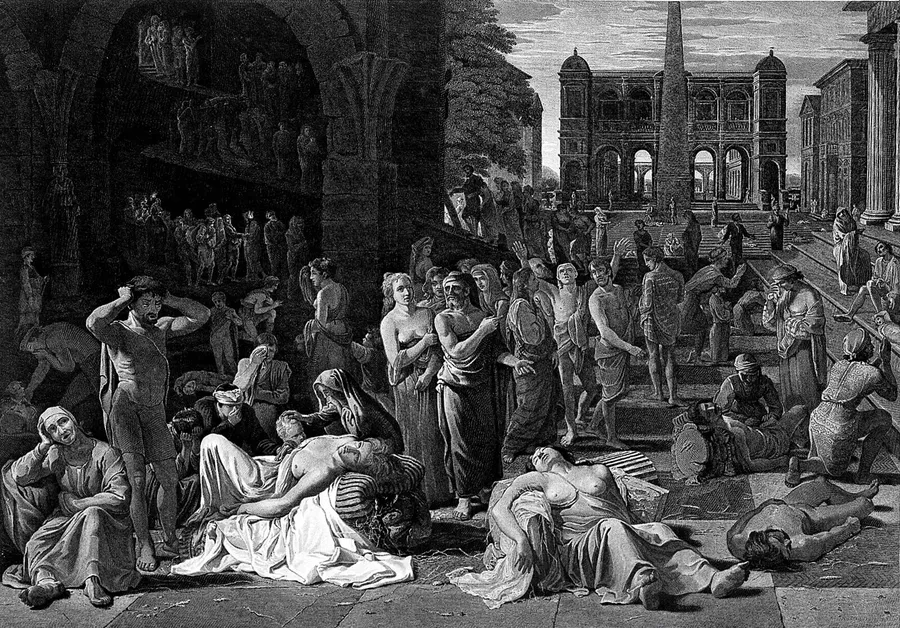
Pericles built Athens’ entire war strategy on a bet: pack the countryside inside the city walls, let the navy do the fighting, and outlast Sparta. It nearly worked. Instead, in the summer of 430 BCE, it filled Athens with refugees, sewage, and rats, and handed a disease the perfect place to explode. Within a few years, something like a quarter of the population was dead, Pericles included. Historians still argue about how much this one epidemic actually cost Athens in the long run, but it’s hard to look at the timeline and not see a city that never quite got back on its feet.
The setup was almost self-inflicted. Rather than meet Sparta’s army in open battle, Pericles evacuated Attica and crammed everyone behind the Long Walls, betting that Athenian ships could keep the city fed while Spartan soldiers wore themselves out on empty farmland. On paper it was smart. In practice it meant tens of thousands of people sleeping in temples, gaps between walls, anywhere with a roof, with none of the sanitation a city that size needed. When the plague arrived through Piraeus, it had ideal conditions and didn’t waste them.
Thucydides caught it and lived, which is the only reason we know anything real about what it looked like: burning fever, red eyes, internal bleeding, skin breaking out in sores, and for a lot of people, death within about a week. Historians have spent literally centuries trying to pin a modern name on it: typhoid, typhus, smallpox, even something Ebola-like — and nobody has managed it, because his symptoms don’t line up cleanly with any single disease we know today. What isn’t in dispute is the death toll: modern estimates land somewhere between a quarter and a third of the city.
The numbers only tell part of it. Pericles died from the plague in 429 BCE, and with him went the one figure who could actually hold Athenian democracy and its war strategy together. Thucydides did write about something almost scarier than the deaths — people abandoning funeral rites, ignoring the law, deciding none of it mattered since they might be dead the next week anyway. That kind of unravelling doesn’t show up in a death count, but it’s arguably more lasting damage: a city that stops trusting its own norms doesn’t easily get them back.
So did the plague end the Golden Age? Not on its own, and not immediately — the war ground on for another twenty seven years, and Athenian art and philosophy didn’t stop the day Pericles died. But it’s hard to call it a coincidence, that a city stripped of its best leader and a chunk of its population, right at the start of a war it needed discipline to win, ended up losing that war in 404 BCE. The plague probably isn’t the whole story of Athens’ decline. It’s just the first domino.
References
Papadimitrakis, Dimosthenis, et al. “The Plague of Athens: Investigating the Enigmatic Epidemic of Ancient Greece.” 2025, ojs.srce.hr/amha/article/view/30214.
“Plague of Athens | History | Research Starters | EBSCO Research.” EBSCO, www.ebsco.com/research-starters/history/plague-athens.