Can a disease take a thousand years to kill an empire?
Not every civilisation-ending disease arrives with trumpets. Some take a thousand years.
“It is impossible to create an unbeatable army if all your soldiers are shivering and feverish.”
Looking back at the dramatic collapses of history, our minds tend to jump straight to cinematic punctuation marks. We think of the smoking ruins of sacked cities, the grotesque horror of the Black Death suddenly, or the terrifyingly quick devastation of smallpox.
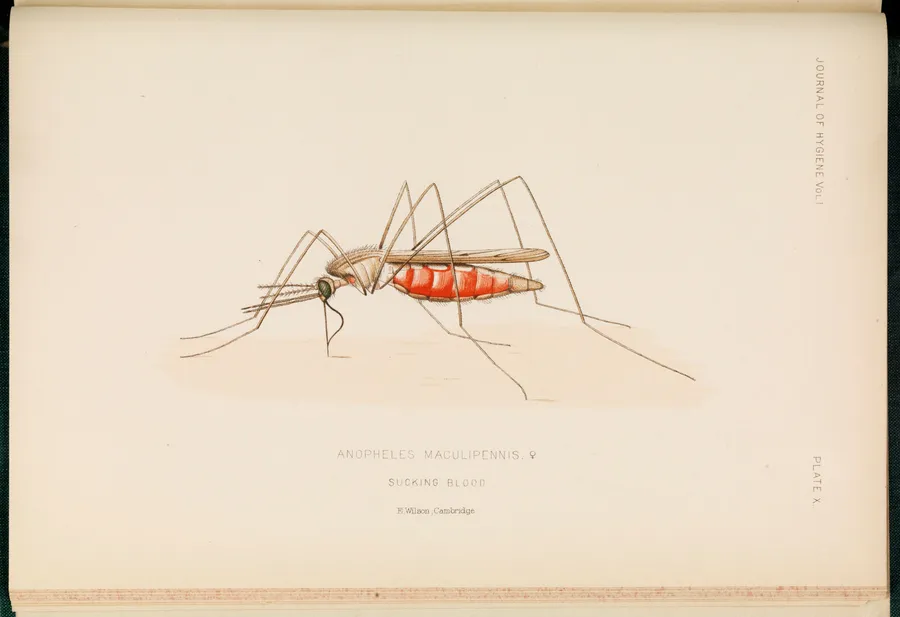
There is another kind of killer in history. It does not come with a dramatic flourish of trumpets, but with the faint, rhythmic buzz of a microscopic wing beat.
In premodern times, a silent, relentless killer was stealthily hollowing out the foundations of humanity’s greatest early empires. Malaria didn’t wipe out ancient Greece, Rome or Mesopotamia in one bloody weekend. Instead it throttled them out decade after decade, generation after generation, in a tragic case of slow murder in history.
Jungle fever of Mesopotamia
The fertile floodplains of the Tigris and Euphrates rivers are famously the birthplace of human civilization. But the very geography that made agriculture possible also made it a paradise for Anopheles mosquitoes.
As early Mesopotamian communities constructed large irrigation systems to feed their expanding cities, they inadvertently created pools of standing water—ideal breeding grounds for disease vectors.
“The sick man’s head is bound with a cord… a burning heat consumes him.” > — A 3,000-year-old Babylonian clay tablet, describing symptoms very much like malarial fever.
The chapters of our textbooks are filled with the fierce conquests of the Assyrians and Babylonians, but it was the seasonal “marsh fever” that quietly established their boundaries. It completely drained the lifeblood of the labour force required to maintain the intricate canal systems. When the canals clogged and the fields dried up, the ensuing collapse of society was often blamed on angry gods, but the real culprit was buzzing inches from their faces.
The Buzz in the Cradle of Philosophy
The disease took root in ancient Greece and changed the whole course of Western thought. By the 4th century BCE, the deadly strain of Plasmodium falciparum had taken firm root in the Greek wetlands.
Although the Greeks could not see the microscopic parasite itself, they knew something was very wrong. Hippocrates, the father of medicine, took careful record of seasonal peaks in what he called “tertian” and “quartan” fevers, noting that they were highest in late summer, when the swamps turned stagnant.
Malaria was not only deadly. It was crippling. It left the population deeply anaemic, chronically lethargic, and mentally fogged. The abrupt end to thriving city-states like Sparta and Athens, according to historians, was not merely political rot, but pure physical fatigue. The endless cycle of fever sapped the Greeks of their demographic vitality, leaving their armies emaciated and their farmlands abandoned to nature.
The “Roman Fever” That Conquered the Conqueror
No place can claim such dark significance in relation to the malaria epidemic than that of Ancient Rome. Malaria-infested low lands, particularly the Pontine Marshes, were identified with the disease to an extent that the most virulent form of the parasite came to be known simply as “Roman Fever.” Throughout history, the ring of swamps surrounding Rome proved to have a two-faced character:
The Sword of Defense: It was employed involuntarily by Rome as a biological weapon against foreign enemies. Hannibal’s Carthaginian army, followed by the Visigoth army, suffered massive losses due to fever without being able to attack Rome. The Worm Inside: It deteriorated the Roman population internally.
The growth of the Roman Empire made their dependence on large farms filled with slaves highly disruptive to the local ecology. Forests were cleared, and their drainage system was neglected. Naturally, the mosquitoes invaded. Recent DNA studies carried out on bones excavated from Roman burial grounds have proven that Plasmodium falciparum was widespread during this period, taking the lives of many babies and weakening the adults. During the decline of the Western Roman Empire, Rome had not only experienced internal strife and attacks by barbarians but a shortage of human capital as well. It is impossible to create an unbeatable army if all your soldiers are shivering and feverish.
The Anatomy of a Slow Murder
But how precisely does the disease manage to bring about the downfall of the civilization in question without there being any panic at all?
Unlike plague, which kills the host in a matter of a few days, malaria operates through gradual attrition. An empire afflicted with endemic malaria is under constant burden in terms of human potential. When the people are constantly weary, they lose their capacity for innovation, for building up their infrastructure and for defending themselves against the threat from the outside. Lethargy and anemia result in poor crops, whereas high levels of infant mortality prevent further population growth. These two factors cause great economic and military weakness of the empire which dies out, too weary to live on.
The experience of those civilizations teaches us the bitter truth that history was not only made by emperors, generals and philosophers but also by the force of nature. When admiring the ruined Roman Forum or the Greek acropolis, think of the fact that the ultimate creator of that scenery might be the tiniest inhabitant of the land.
References
Sallares, Robert. Malaria and Rome: A History of Malaria in Ancient Italy. Oxford University Press, 2002.
Scheidel, Walter. “Disease and Demography in the Roman World.” Journal of Roman Archaeology, vol. 14, 2001, pp. 99-114.
Grmek, Mirko D. Diseases in the Ancient Greek World. Johns Hopkins University Press, 1989.
Harper, Kyle. The Fate of Rome: Climate, Disease, and the End of an Empire. Princeton University Press, 2017.