Did lice beat Napoleon before Russia did?
600,000 men crossed the Niemen. 100,000 came back. The winter gets the credit; the lice did the work.
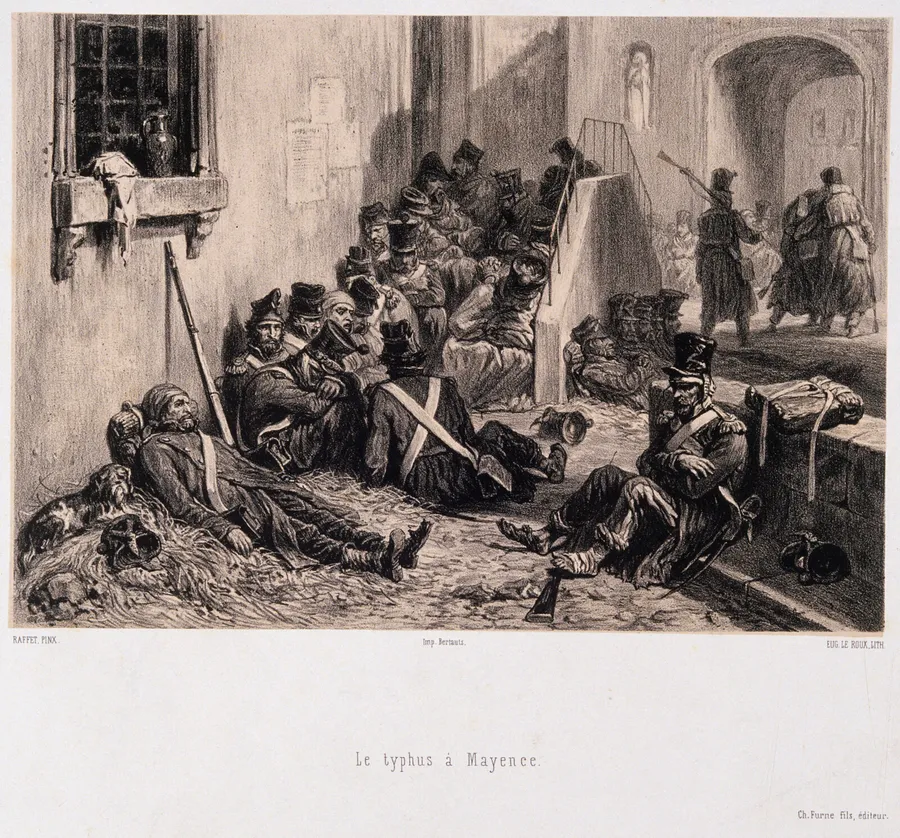
“Disease had quietly dismantled the very machine that had conquered Europe.”
“The Grand Army was defeated less by Russian bullets than by an invisible enemy marching alongside it.”
When Napoleon Bonaparte crossed the Niemen River in June 1812, he commanded the largest military force Europe had ever seen. Nearly 600,000 soldiers from across his empire marched east toward Russia, convinced they would return after another swift victory. Instead, only around 100,000 made it back. While the brutal Russian winter has long been blamed for the disaster, historians and epidemiologists now agree that an even deadlier enemy struck first: typhus.
Typhus is a bacterial disease caused by Rickettsia prowazekii and spread by body lice. Today, it is relatively rare and easily treated with antibiotics. Two centuries ago, however, it was one of history’s most feared killers. Wherever overcrowding, poor sanitation, and malnutrition existed, typhus flourished. Armies were the perfect breeding ground.
Napoleon’s invasion force was enormous, but it was also chaotic. Soldiers slept packed together, often went weeks without changing clothes, and had little opportunity to bathe. Lice spread rapidly through uniforms, blankets, and camps. Once infected, soldiers developed high fevers, severe headaches, muscle pain, delirium, and a distinctive rash. Many died within days. Those who survived were often too weak to continue marching.
The disease began devastating Napoleon’s army almost immediately after it entered present-day Lithuania. Entire units lost thousands of men before they had even encountered Russian forces. As supply lines stretched further across Eastern Europe, food became scarce, and medical care collapsed. Starving soldiers were even more vulnerable to infection, creating a vicious cycle in which disease and hunger reinforced each other.
The Russians unintentionally worsened the situation through their scorched-earth strategy. As they retreated, they destroyed crops, villages, and supplies that Napoleon hoped to capture. Without food or shelter, exhausted soldiers were forced into increasingly unsanitary conditions, allowing lice to spread even faster. Ironically, one of the greatest military strategies in history succeeded not simply because it denied Napoleon resources, but because it created ideal conditions for disease.
When Napoleon finally ordered the retreat from Moscow, winter had only just begun. Freezing temperatures, starvation, and repeated Russian attacks transformed the withdrawal into one of history’s greatest military catastrophes. Yet by then, much of the damage had already been done. An army weakened by months of typhus could no longer fight effectively, build bridges quickly, or maintain discipline. Disease had quietly dismantled the very machine that had conquered Europe.
The consequences extended far beyond Russia. Napoleon lost the experienced veterans who had formed the backbone of his empire. His enemies recognised his weakened position and formed the Sixth Coalition, eventually defeating him at the Battle of Leipzig in 1813 before forcing his abdication the following year. While Napoleon would briefly return during the Hundred Days, the strength of his empire had already been irreversibly broken.
The Russian campaign serves as a reminder that history is not shaped solely by kings, generals, and battles. Sometimes, microscopic organisms alter the fate of nations more profoundly than any military genius. Typhus never appeared on Napoleon’s battle plans, yet it became one of his most formidable opponents.
The fall of Napoleon’s empire is often remembered as a story of strategic miscalculations and the harsh Russian winter. In reality, it was also a story of biology. Long before modern medicine understood bacteria or disease transmission, a tiny louse carrying an invisible pathogen helped bring down the most powerful army in Europe. Sometimes, the greatest turning points in history are decided not on the battlefield, but under the microscope.
References
No reference list has been supplied for this article yet. Every other article in this issue cites its sources; this one is live ahead of that, at the editor’s request, while the author’s references are still being collected.